
Walmart Returns Metrics by Condition: Seller Action Guide
Use Walmart's New and Resold returns metrics to find listing, quality, packaging, and customer-expectation problems and choose the right action.

Muhammed Nasser
October 19, 2026
Walmart Marketplace now separates returns performance by item condition in its Seller performance reporting. The REPORT notification can distinguish NEW inventory, covering New and Collectibles, from RESOLD inventory, covering Pre-Owned and Restored items. That split gives sellers a faster way to decide where an investigation should begin. It does not diagnose the cause automatically, but it can help teams avoid a broad response when the signal is limited to one operating model. The practical goal is to connect each condition-group movement to item-level evidence, a targeted corrective action, and a later measurement period.
What Walmart changed in returns reporting
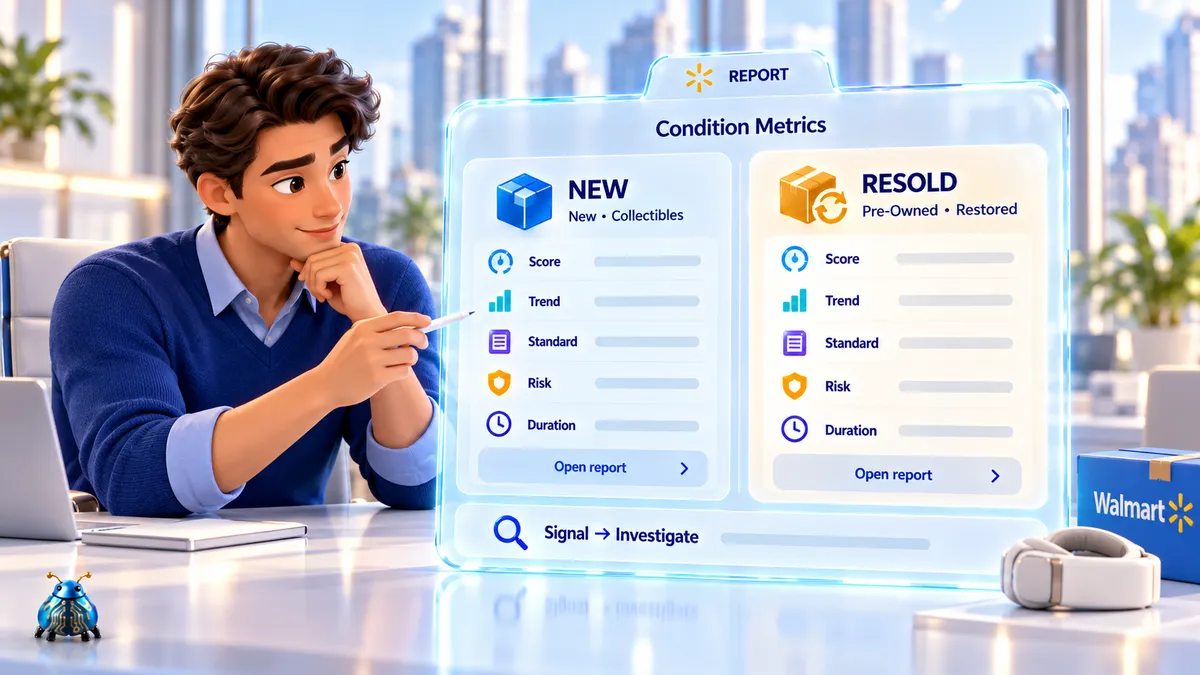
Walmart's official October 9, 2026 developer update says the Seller performance REPORT notification includes a Returns KPI grouped into:
- NEW: New and Collectibles
- RESOLD: Pre-Owned and Restored
For each applicable group, the report can include a returns score, trend, performance standard, risk level, duration, and a link to the relevant report. These fields tell a seller where performance may require attention; they do not identify the responsible product or root cause on their own.
| Signal | Signal | Next step |
|---|---|---|
| Next step | Is the issue limited to New/Collectibles or Pre-Owned/Restored? | Is the issue limited to New/Collectibles or Pre-Owned/Restored? |
| Is the issue limited to New/Collectibles or Pre-Owned/Restored? | Is the issue limited to New/Collectibles or Pre-Owned/Restored? | Is the issue limited to New/Collectibles or Pre-Owned/Restored? |
| Standard and risk level | Standard and risk level | Standard and risk level |
| Standard and risk level | Standard and risk level | Standard and risk level |
Walmart's September 11 notice had initially described Returns-New and Returns-Resold as planned for October 19. The October 9 condition-specific update is the more current technical source. Sellers should validate the latest documentation and the output in their own account or integration.
Why the condition split changes seller diagnosis
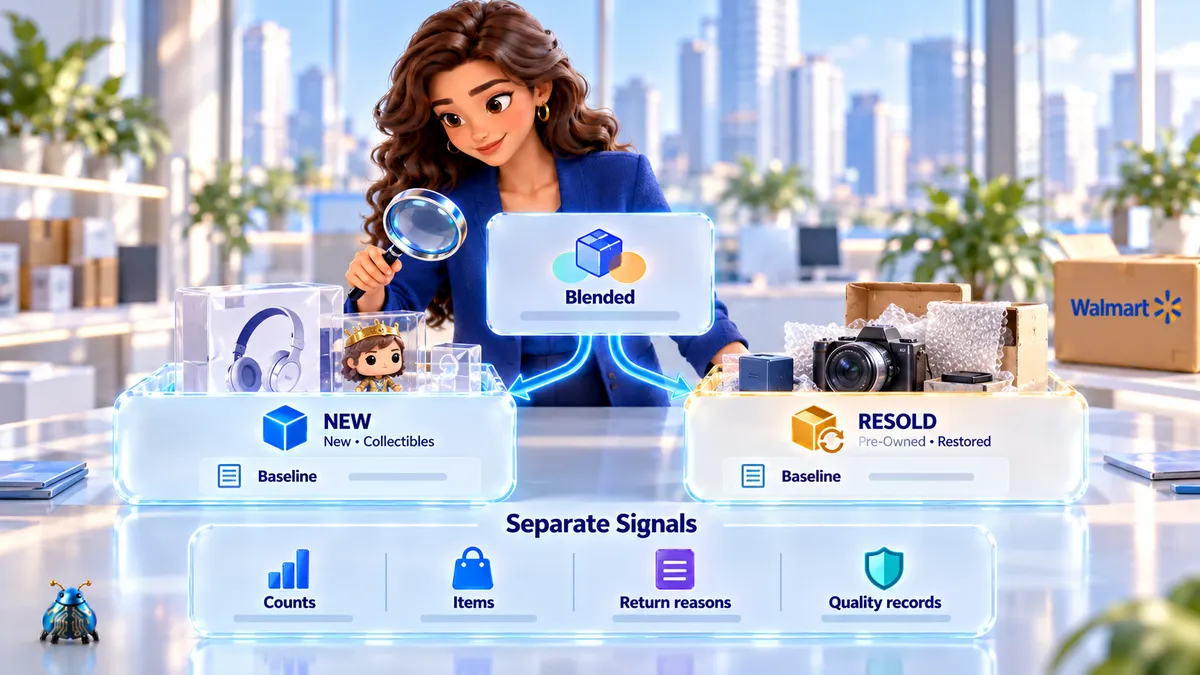
A blended metric can conceal different patterns. Stable New-item performance can dilute a problem in Restored inventory, while a large Pre-Owned assortment can make a smaller New-item problem harder to see. The split helps a seller decide which process to inspect first.
| Pattern | First hypothesis | Evidence to check |
|---|---|---|
| NEW worsens; RESOLD stable | New-item quality, factory packaging, listing accuracy, or fulfillment change | Supplier lots, damage records, affected SKUs, recent content edits |
| RESOLD worsens; NEW stable | Grading, restoration quality, missing parts, or condition disclosure | Inspection logs, grading notes, accessory checks, condition text |
| Both worsen | Shared packaging, fulfillment, content, promotion, or demand-quality issue | Common SKUs, carrier and warehouse data, price and promotion changes |
| Movement on low volume | Small-sample volatility | Orders, return counts, duration, and SKU concentration |
Preserve a condition-level baseline before reacting. Record the report date, duration, score, trend, standard, risk level, and report link for each group. Add order volume, return counts, item mix, promotions, fulfillment changes, and catalog edits for the same period. Then open the linked report and connect the condition signal to affected products, return reasons, customer language, quality records, packaging, and fulfillment evidence.
Treat return reasons as clues. A "not as described" return may originate in condition disclosure, missing components, inaccurate content, or failed inspection. A damage return may come from product quality, packaging, handling, or delivery. The condition split narrows the search; it does not finish it.
Match corrective actions to the evidence
| Evidence | Action | What to monitor |
|---|---|---|
| Condition-expectation gap | Clarify cosmetic state, included parts, packaging, and condition notes | Condition-group trend and related return reasons |
| Repeated Restored-item failure | Strengthen testing and quarantine the affected process or batch | Functional-failure returns for affected SKUs |
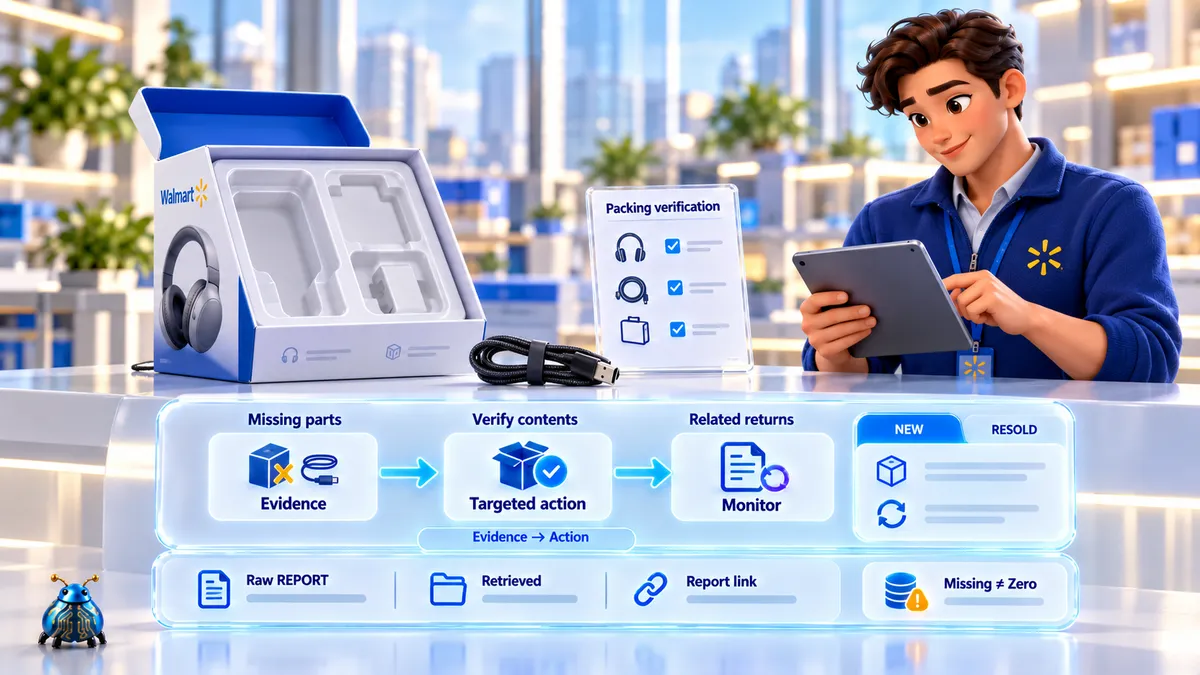
| Missing accessories | Add packing verification and align the listing with shipped contents | Component-related complaints and returns |
| Damage across both groups | Test packaging and isolate warehouse, handler, or route concentration | Damage returns by SKU and fulfillment path |
| Compatibility confusion | Correct attributes, titles, bullets, and fit guidance | Compatibility-related returns and conversion quality |
or integrations, archive the raw REPORT payload, preserve the retrieval timestamp and report link, and validate which condition groups are present. Do not convert a missing group to zero without checking catalog applicability, reporting coverage, and integration health. Use Walmart's live technical documentation as the schema authority.
FAQ
Walmart groups New and Collectibles under NEW, and Pre-Owned and Restored under RESOLD.
No. It is a segmentation signal. Root-cause analysis still requires item-level return reasons, customer feedback, listing content, quality-control, packaging, and fulfillment evidence.
Save the reporting date and duration, condition group, score, trend, standard, risk level, report link, and underlying business context such as orders, return counts, promotions, item mix, and operational changes.
Validate the current REPORT schema, preserve raw payloads, store the condition-level values and report link, and route adverse trends or elevated risk to an owner for item-level investigation.
Conclusion
Walmart's condition split makes returns performance more actionable by showing whether the signal sits in New and Collectibles, Pre-Owned and Restored, or both. Its value depends on disciplined follow-through: preserve a baseline, trace the movement to item-level evidence, apply a targeted correction, and measure the next comparable period. The report is a better starting point, not a substitute for diagnosis.
Sources
2 refrences
Ready to Take the Next Step?
Bluebug helps marketplace sellers analyze Walmart returns, improve listings, product quality, packaging, and customer expectations through measurable decisions.
Keep reading
Walmart MCS Webhooks: Orders, Shipments, and Returns
Build a reliable Walmart MCS webhook integration with event mapping, durable receipt, idempotency, retry controls, and reconciliation.

Amazon Ads Agent and DVA+: A Seller Brand Test Plan
Verify rollout status and test Amazon Ads Agent and DVA+ with clear budget, targeting, creative, bidding, and measurement controls.

Amazon Black Friday Deals 2026: October 20 Seller Checklist
Use an eight-day Amazon deal sprint to check margin, eligibility, inventory, submission evidence, and deal health before the October 20 deadline.