
Amazon marketing services: The Complete 2026 Strategy Playbook
Master Amazon marketing services to scale revenue. Compare native ads, agency models, and retail readiness prerequisites. Audit your ad strategy today.

Muhammed Nasser
September 9, 2026
By SAMH, Amazon Marketplace Strategist & E-Commerce Consultant.
Amazon marketing services drive scalable revenue growth across the retail marketplace by combining sponsored search placements with programmatic display reach. However, launching ad campaigns without fixing underlying product conversion flaws wastes capital. This operational guide examines the modern Amazon Ads suite, evaluates external agency management models, and outlines the essential listing prerequisites necessary to maintain profitable margins.
What Are Amazon Marketing Services? (From Legacy AMS to Amazon Ads Console)
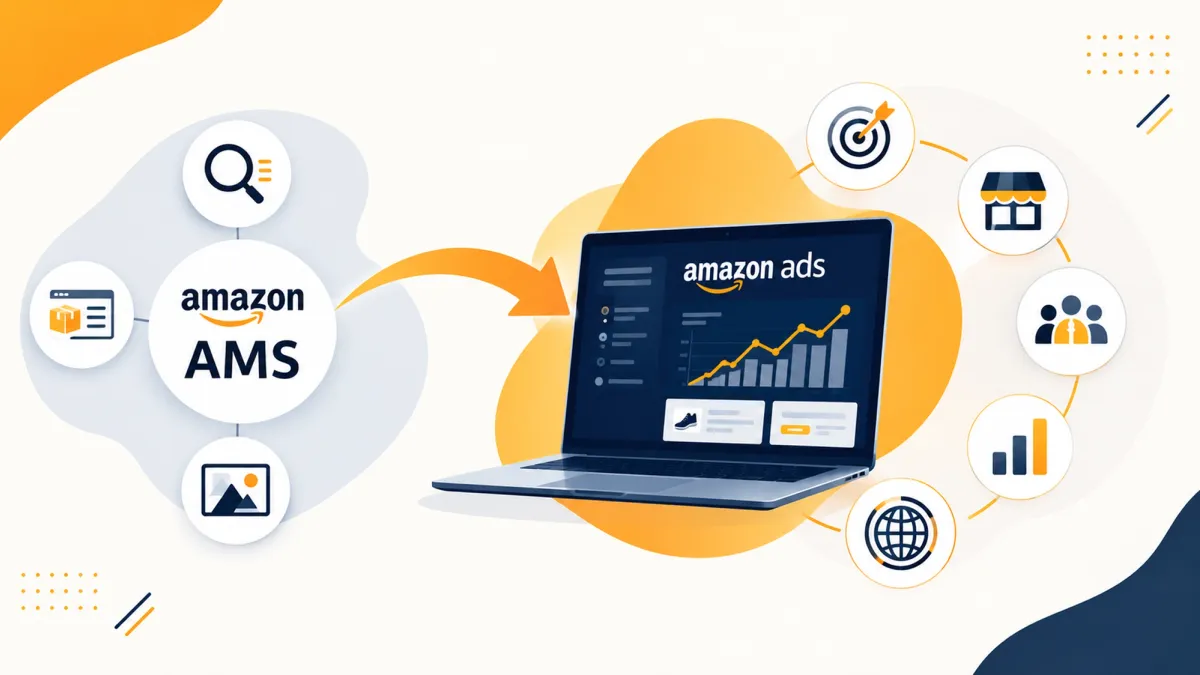
Amazon marketing services originally referred to AMS, a standalone portal providing search marketing tools exclusively to Amazon Vendor Central accounts.
Amazon subsequently consolidated its advertising capabilities under the unified Amazon Ads Console. This change merged vendor marketing features with Seller Central self-serve advertising.
Today, the term refers both to Amazon's native suite of retail media ad solutions and to specialized management services provided by external growth agencies.
Accessing these solutions requires an active professional selling account, registered vendor relationship, or brand registry enrollment via the Amazon Ads registration portal.[1]
What is the difference between AMS and modern Amazon Ads?
Legacy AMS provided three basic formats: Headline Search Ads, Sponsored Products, and Product Display Ads. Management features were limited and siloed by seller tier.
The modern console integrates advanced programmatic media, dynamic brand storefronts, audience retargeting, and server-side conversion modeling across global marketplaces.
Core Pillars of Amazon Marketing: Ad Formats & Placement Strategies
Maximizing revenue on the platform requires deploying ad placements aligned with customer intent at each stage of the retail buying journey.
Brands scale discoverability by orchestrating four primary ad solutions across search results pages, competitor listings, and off-platform digital placements.
| Ad Format | Primary Placement | Targeting Mechanism | Ideal Strategic Objective |
|---|---|---|---|
| Sponsored Products | Top of Search, Rest of Search, Product Detail Pages | Keywords & ASIN Product Targeting | Direct conversion, organic ranking growth, keyword dominance |
| Sponsored Brands | Above search results, bottom banner, video in-grid | Keyword search intent & category conquesting | Brand recall, multi-product cross-selling, Storefront traffic |
| Sponsored Display | Product pages below Buy Box, customer review sections | Audience interests, views remarketing, purchased ASINs | Defending listing real estate, re-engaging past shoppers |
| Amazon DSP | Twitch, Prime Video, Fire TV, third-party web/apps | First-party deterministic shopper behavioral segments | Upper-funnel awareness, programmatic off-Amazon customer acquisition |
Sponsored Products: The Engine of Direct Conversion
Sponsored Products account for the majority of marketplace ad spend. These ads appear natively in search results and directly mimic organic listings.
Automated match types (close match, loose match, complements, substitutes) harvest search terms. Manual campaigns (exact, phrase, broad match) capture high-intent buyers.
Sponsored Brands and Video Placements
Sponsored Brands showcase your custom brand logo, a headline, and up to three featured products. They drive shoppers to your custom Brand Storefront.
Sponsored Brands Video placements auto-play in search results, demonstrating product functionality and delivering substantially higher click-through rates than static images.
Sponsored Display and Programmatic Amazon DSP
Sponsored Display enables sellers to defend their listing real estate by placing retargeting ads beneath their own Buy Box or targeting competing ASINs.
Amazon DSP operates programmatically. It reaches audiences across Amazon devices and external web properties using Amazon's deterministic first-party purchasing data.
Retail Readiness: The Prerequisite Before Spending Ad Capital
Driving paid traffic to an unoptimized product detail page destroys profit margins. Retail readiness defines whether an ASIN can convert incoming paid clicks efficiently.
Before allocating budget to paid campaigns, brands must audit conversion factors including Buy Box ownership, listing copywriting, and authentic customer feedback.
Strategic sellers partner with professional Amazon marketplace growth experts to audit listing health, identify conversion bottlenecks, and resolve operational defects before launching ad spend.
| Retail Readiness Factor | Minimum Standard | Advertising Risk If Ignored |
|---|---|---|
| Buy Box Ownership | >95% Buy Box share | Sponsored Products pause automatically; external traffic converts for competitors |
| Review Rating Score | 4.0 Stars or higher | Click-through rates drop; ad conversion cost spikes significantly |
| Review Quantity | Minimum 15-25 authentic reviews | Shoppers abandon cart due to lack of social proof |
| Visual Assets | 6+ high-res images, video, A+ Content | High bounce rates; low return on ad spend (ROAS) |
| Inventory Depth | 4-8 weeks of stock cover | Stockouts kill organic rank gains generated by ad velocity |
Why is my Amazon PPC bleeding money despite high traffic?
When ad clicks generate sessions without conversions, listing friction is the root cause. Unfavorable customer feedback or negative reviews prominently displayed on product pages undermine buyer trust instantly.
When negative reviews violate marketplace community standards or contain demonstrably false competitor claims, utilizing a dedicated compliant review removal service restores listing conversion rates and protects paid advertising efficiency.
Regulatory frameworks such as the FTC's guidance on online reviews mandate strict authenticity standards, making policy-compliant reputation management mandatory for sustainable marketplace growth (Federal Trade Commission Guidance on Online Reviews).[2]
Sellers must systematically analyze how feedback affects sales. Understanding how to use Amazon review services to remove negative reviews and improve your sales ensures advertising budgets drive profitable purchases rather than wasted clicks.
In-House Advertising vs. Hiring Professional Amazon Marketing Services
Scaling brands must decide whether to manage advertising campaigns using in-house teams or delegate execution to specialized agency partners.
Each operational model presents distinct financial trade-offs, resource demands, and technical skill requirements.
| Management Model | Typical Cost Structure | Key Advantages | Primary Drawbacks |
|---|---|---|---|
| In-House Team | Fixed salary + software licenses ($70k-$120k/yr) | Dedicated product focus, deep brand alignment | High overhead, limited multi-account tactical insights |
| Specialized Agency | Base retainer + % of ad spend (or revenue share) | Cross-category testing data, enterprise tooling access | Variable management fees, divided account attention |
| Hybrid Execution | In-house strategist + tactical agency execution | Strategic control paired with execution bandwidth | Requires structured communication and accountability |
Is hiring an Amazon PPC agency worth the percentage fee?
Hiring an external agency is cost-effective when the agency generates incremental gross margin that exceeds its fee. Agencies provide proprietary software, Dayparting scripts, and Amazon DSP seat access that smaller brands cannot justify purchasing independently.
Ensuring complete account stability requires pairing advertising with holistic expert Amazon account management services to handle inventory forecasting, listing compliance, and operational escalations simultaneously.
Brand protection strategies must also integrate ongoing reputation defense. Implementing online reputation management services to revive Amazon credibility ensures negative customer experiences do not diminish agency campaign performance.
2026 Platform Updates: Amazon Marketing Cloud and Media Regulations
As verified on September 6, 2026, the marketplace advertising ecosystem has shifted toward deterministic cross-channel data modeling and tighter regulatory accountability.
Government bodies continue enforcing strict transparency across automated digital ad marketplaces, as detailed in the UK Online Advertising Taskforce Progress Report.[3]
Amazon Marketing Cloud (AMC) Custom Attribution
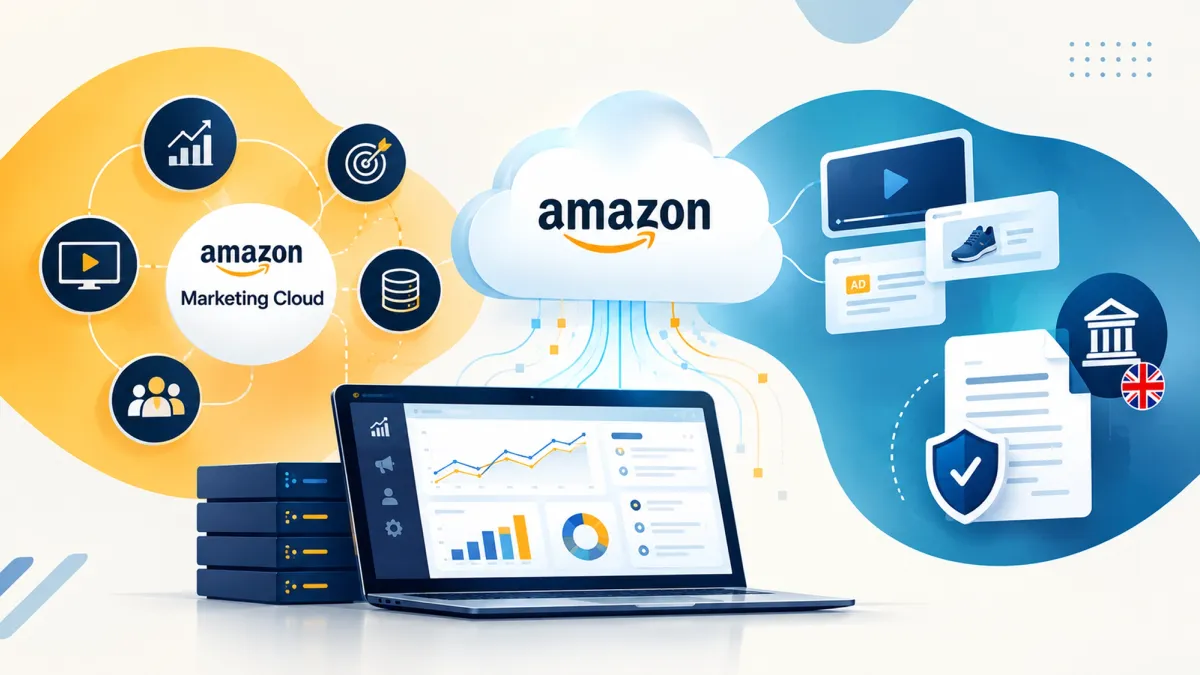
Amazon Marketing Cloud operates as a secure, privacy-compliant data clean room where advertisers query event-level data sets using SQL.
AMC allows brands to measure multi-touch attribution, showing how upper-funnel Prime Video or DSP display impressions assist bottom-of-funnel Sponsored Products search conversions.
Algorithmic Bidding and Conversational Search
Modern Amazon marketing services utilize machine learning algorithms to adjust bids based on device, placement, historical conversion likelihood, and real-time inventory levels.
AI-driven conversational shopping assistants on the marketplace now influence search ranking, rewarding products with complete catalog data and high customer review sentiment scores.
Key Performance Indicators: Calculating ACoS, TACoS, and True Profit
Evaluating advertising success requires tracking granular metrics that reflect total business health rather than isolated campaign performance.
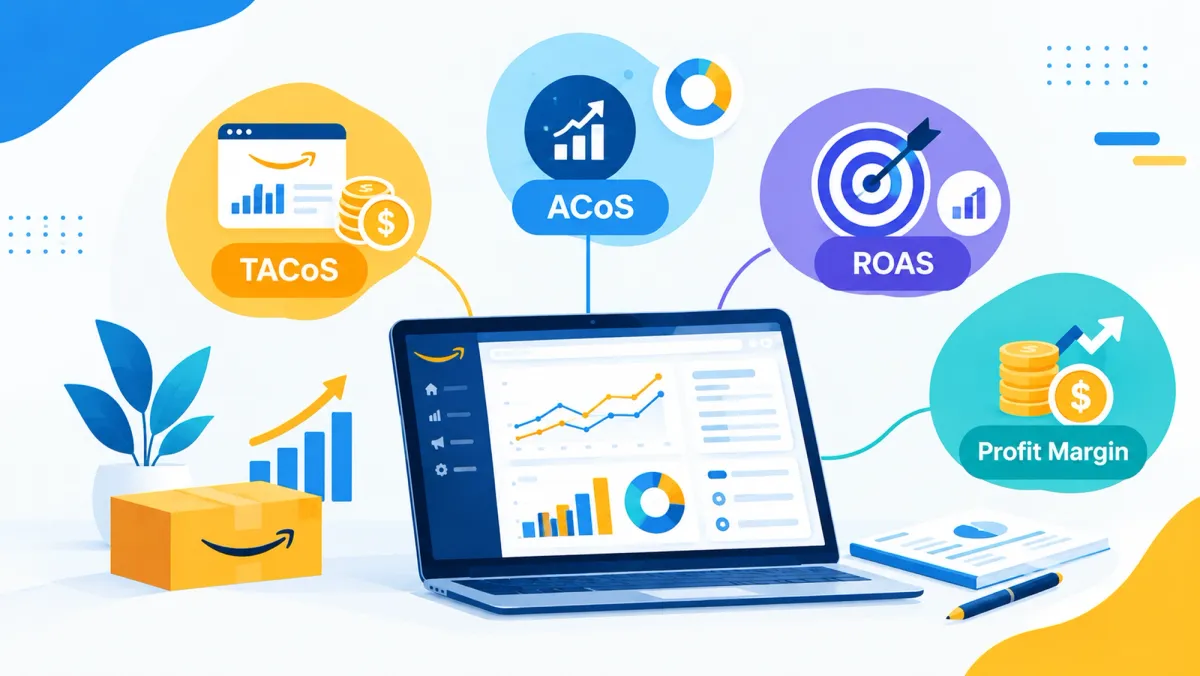
Relying solely on Advertising Cost of Sales (ACoS) creates a distorted picture of overall brand profitability.
Formulas for Strategic Media Measurement
- ACoS (Advertising Cost of Sales): (Total Ad Spend / Total Ad Revenue) × 100. Measures direct campaign efficiency.
- TACoS (Total Advertising Cost of Sales): (Total Ad Spend / Total Overall Revenue) × 100. Measures the impact of advertising on total marketplace revenue growth.
- ROAS (Return on Ad Spend): Total Ad Revenue / Total Ad Spend. The inverse of ACoS.
- Blended Profit Margin: Net profit after deducting COGS, Amazon FBA fees, operating expenses, and ad spend.
How to Interpret TACoS Trajectories
A declining or stable TACoS alongside growing total revenue indicates that paid ad velocity is successfully lifting organic search rankings.
An increasing TACoS alongside stagnant total revenue indicates that paid ads are cannibalizing organic sales or compensating for deteriorating listing conversion rates.
Step-by-Step Vetting Checklist for Selecting an Amazon Marketing Agency
Before signing an agency retainer, conduct a rigorous audit of their operational capabilities, fee transparency, and campaign management methodologies.
- Audit Structure and Negative Keyword Hygiene: Ensure the agency isolates match types into separate ad groups and systematically harvests negative search terms weekly to eliminate wasted spend.
- Proprietary Tech vs. Third-Party Tools: Clarify whether the agency uses commercial bid automation tools, custom scripts, or manual bid adjustments.
- Contractual Ownership and Data Portability: Verify that all campaign structures, data history, and Amazon DSP audience segments remain your brand's property if the engagement ends.
- Holistic Catalog Understanding: Confirm the agency tracks listing health, suppressed buy boxes, stockout forecasts, and review sentiment alongside ad bids.
Frequently Asked Questions About Amazon marketing services
The primary ad campaigns are Sponsored Products for keyword search targeting, Sponsored Brands for creative storefront awareness, Sponsored Display for detail page audience retargeting, and Amazon DSP for off-platform programmatic video and display media.
Professional agency services typically charge a monthly base retainer ranging from £1,500 to £5,000, often combined with 3% to 10% of monthly ad spend. Hybrid models may include performance-based incentives tied to total marketplace revenue growth.
A good ACoS depends entirely on your product profit margins. For mature products, a target ACoS between 15% and 25% delivers sustainable profitability. For new product launches, an ACoS equal to the break-even profit margin (35% to 45%) is acceptable to build sales velocity.
Advertising improves organic rankings only if paid clicks convert into sales. The algorithm rewards sales velocity. If high ad spend yields poor conversion rates due to negative reviews or uncompetitive pricing, organic search rank will drop.
Signs of wasted budget include unmonitored broad-match search terms, lack of negative keyword lists, ad spend continuing on out-of-stock items, and an increasing TACoS without a corresponding rise in overall marketplace revenue.
New campaigns require roughly two to four weeks of data collection to identify top-performing keywords, calibrate bids, and build historical relevance scores. Full-funnel DSP and programmatic retargeting campaigns typically require 60 to 90 days for complete attribution modeling.
Resources and Further Reading
4 refrences
- 01
Amazon Ads Official Portal
Official portal for registering and deploying Sponsored Ads and DSP programmatic media.
advertising.amazon.com
- 02
UK Online Advertising Taskforce Report
Government regulatory framework on retail media transparency and digital advertising standards.
gov.uk
- 03
FTC Guidance on Online Reviews and Endorsements
Federal trade standards regarding authentic customer reviews and marketplace consumer protection
ftc.gov
- 04
Bluebug YouTube channel
practical video guidance from Bluebug.
www.youtube.com
Conclusion
Deploying Amazon marketing services effectively requires balancing precise paid media execution with rigorous listing retail readiness. Whether managing Sponsored Ads in-house or partnering with a dedicated growth agency, sustainable marketplace scale depends on maintaining strong conversion fundamentals, protecting listing reputation against policy-violating negative reviews, and measuring performance via holistic TACoS metrics.
Ready to Take the Next Step ?
Need help protecting your Amazon brand and addressing policy-violating reviews? Contact Bluebug to discuss your case.
Keep reading

UK Seller Fulfilled Prime Requirements: 2026 Action Guide
Prepare for Amazon UK's October tier-level SFP measurement and January enforcement with standard-size delivery and extra-large carrier controls.
Walmart Returns Metrics by Condition: Seller Action Guide
Use Walmart's New and Resold returns metrics to find listing, quality, packaging, and customer-expectation problems and choose the right action.
Walmart MCS Webhooks: Orders, Shipments, and Returns
Build a reliable Walmart MCS webhook integration with event mapping, durable receipt, idempotency, retry controls, and reconciliation.