
Amazon’s November 2 Insurance Rules: A Compliance Guide for Safety Category Sellers
Learn which Amazon sellers face the November 2, 2026 insurance expansion, how to audit affected ASINs and COIs, submit evidence, resolve rejections, and maintain ongoing compliance.

Muhammed Nasser
October 5, 2026Amazon’s November 2, 2026 insurance expansion adds a product-level trigger for enhanced-safety categories alongside the existing monthly-sales trigger. Sellers need to map affected ASINs to the correct insured entity and policy, verify that the underlying coverage includes those products, and preserve evidence through submission and renewal. Mainland China sellers also face a separate route for new policy submissions.
What Changes on November 2, 2026, and Which Sellers Are Affected
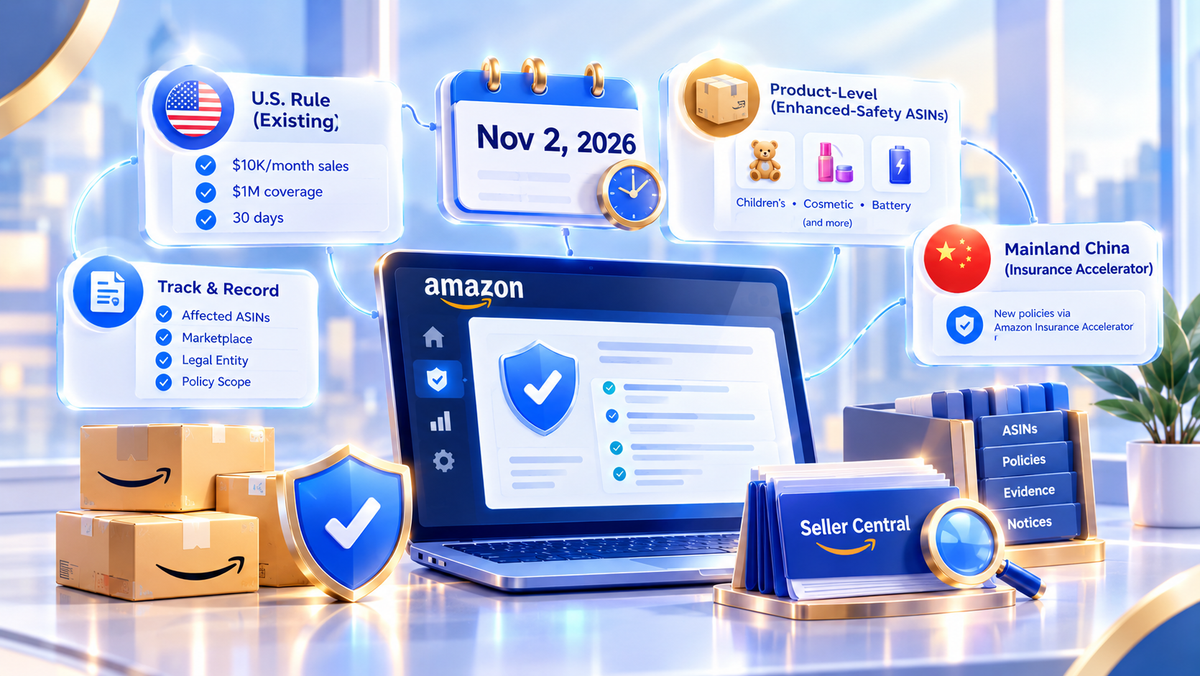
Amazon says the existing U.S. rule remains: sellers must obtain and maintain commercial liability insurance within 30 days after Amazon.com gross proceeds exceed $10,000 in a month, with at least $1 million per occurrence and in aggregate.
The expansion adds a separate product-level trigger. Sellers with enhanced-safety ASINs need coverage for those products regardless of monthly sales, and the rule applies to new and existing listings. Amazon names children’s products, cosmetic and ingestible products, and lithium-battery products as examples, but the list is not exhaustive.
Sellers in Mainland China face a route-specific rule. From November 2, newly submitted policies must come through Amazon Insurance Accelerator. A qualifying third-party policy submitted earlier may continue until expiry.
Record each affected ASIN, marketplace, legal entity, and policy scope. Treat authenticated Seller Central requirements, affected-ASIN information, and account notices as the operational source of truth.
How to Audit Your Certificate of Insurance Before Uploading It
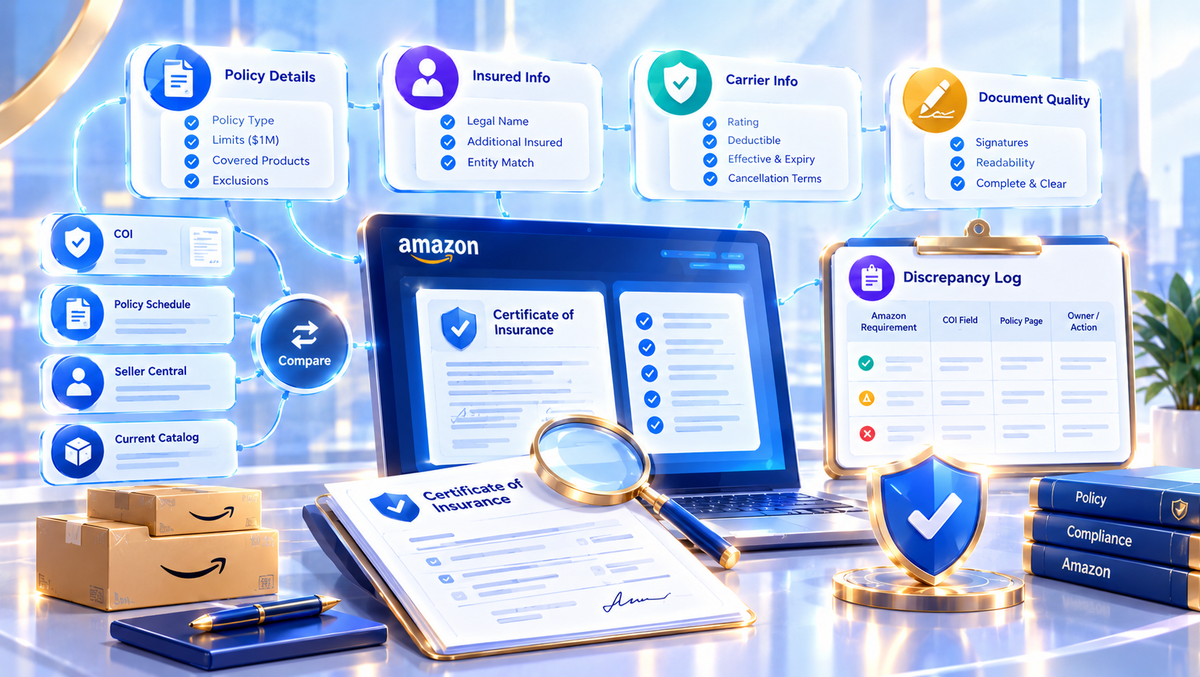
A COI proves that a policy exists; it does not replace reading the policy. Compare the COI, policy schedule, Seller Central legal entity, and current catalog.
Confirm the policy type, $1 million limits, covered products, exclusions, insured legal name, additional-insured wording, insurer rating, deductible requirement, effective and expiry dates, cancellation terms, signatures, and readability. Check the authenticated Business Insurance requirements because Amazon’s public deductible guidance is inconsistent.
Create a discrepancy log with the Amazon requirement, COI field, policy page, and owner/action. A COI with sufficient limits can still fail if the policy excludes the enhanced-safety product or the insured name does not match the Seller Central entity.
How to Build an Ongoing Insurance Renewal and Catalog-Control Process
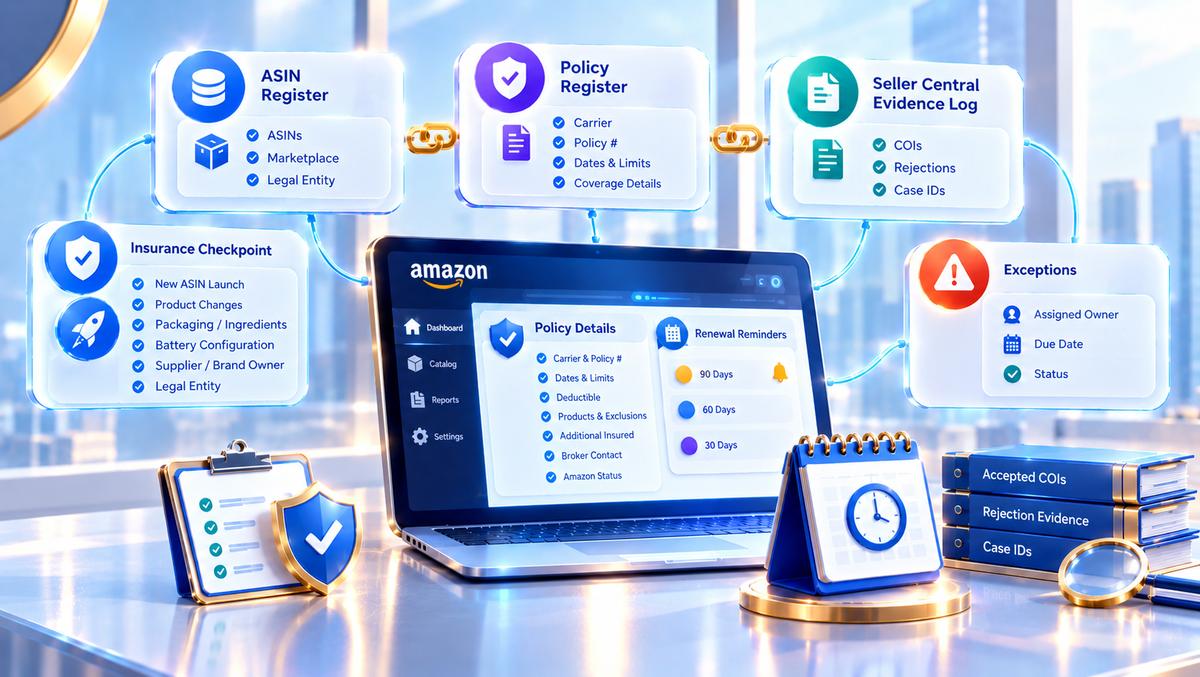
Connect three records: the ASIN register, policy register, and Seller Central evidence log. Add an insurance checkpoint before every new ASIN launch and recheck when product specifications, packaging, ingredients, battery configuration, supplier, brand owner, or legal entity changes.
Record the carrier, policy number, dates, limits, deductible, products, exclusions, additional-insured wording, broker contact, and Amazon acceptance status. Internal reminders at 90, 60, and 30 days before expiry can provide a practical buffer, though this cadence is not an Amazon requirement.
Assign each exception to a named owner and due date. Retain accepted COIs, rejection evidence, and case IDs so renewals and disputes do not restart from memory.
FAQ
The account-level trigger still applies when Amazon.com gross proceeds exceed $10,000 in a month. The expansion adds a product-level trigger for sellers with enhanced-safety ASINs, even below that sales threshold. Confirm the current requirement in the authenticated account.
No. One enhanced-safety ASIN may create an insurance obligation regardless of account sales. Amazon’s public category examples are not exhaustive.
Check the insured legal name, policy type, limits, covered products, exclusions, additional-insured wording, insurer rating, deductible requirement, dates, and document completeness. Compare the COI with both the underlying policy and Seller Central entity.
Amazon says newly submitted policies from November 2, 2026 must come through Amazon Insurance Accelerator. A qualifying third-party policy submitted before the effective date may continue until expiry.
Conclusion
The expansion makes insurance a catalog-control issue. Sellers should identify affected ASINs, verify that the policy covers the right entity and products, submit evidence through authenticated routes, and retain a complete audit trail. Where public guidance, authenticated requirements, or account messages conflict, preserve the discrepancy and obtain written clarification.
Sources
3 refrences
Ready to Take the Next Step?
Turn catalog and customer signals into traceable seller actions with Bluebug's review management platform.
Keep reading
Amazon Dangerous-Goods Questions: October 26 Guide
Prepare product evidence for Amazon’s new dangerous-goods listing questions covering refrigerants, suspension components, writing instruments, and pool or spa chemicals.
Prime Big Deal Days 2026: Final-Week Seller Plan
Use this final-week Prime Big Deal Days checklist to protect inventory, margin, ads, listings, customer experience, and post-event Q4 decisions.
Amazon Local Selling: The Complete Guide for Sellers in 2026
Learn how Amazon Local Selling works, its benefits, fulfillment options, eligibility, setup process, and how sellers can use local sales to grow their business.